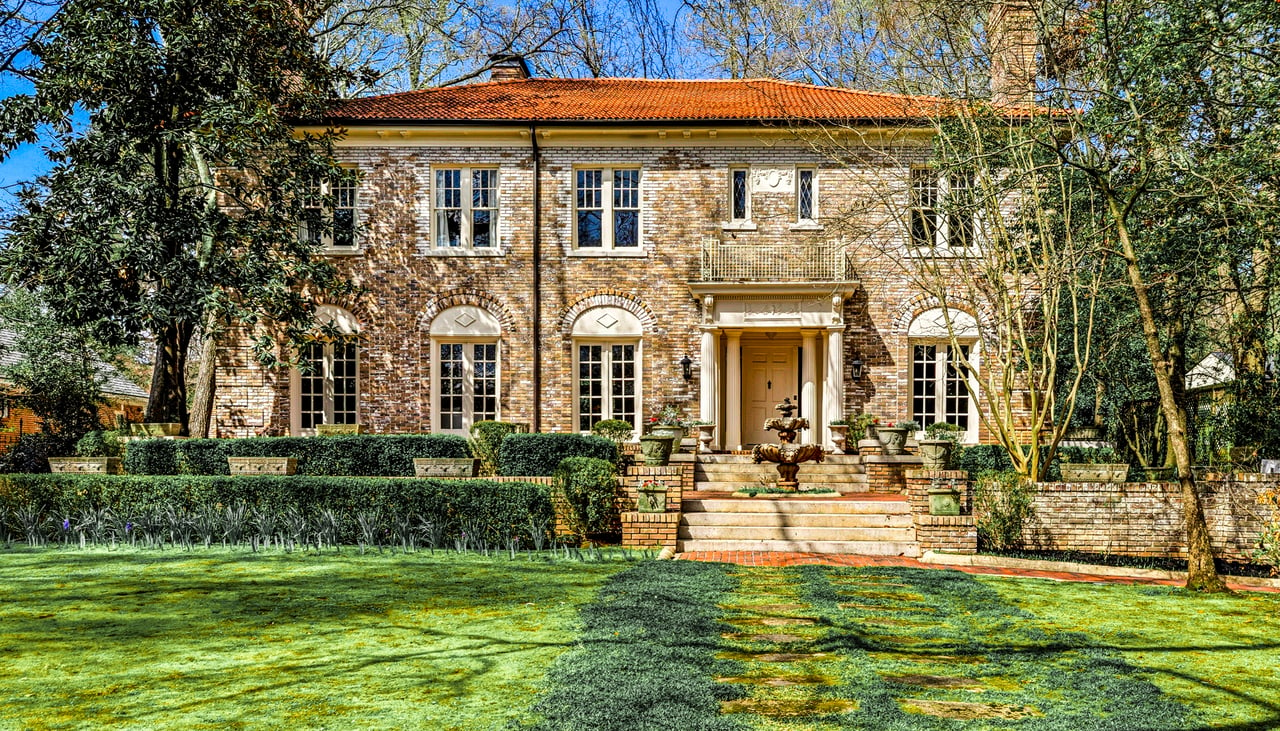
A house can outlive everyone who ever lived in it and still have almost nothing to say. “Boxwood” is the opposite. This 1910 estate at 794 Springdale Road NE in Historic Druid Hills holds more history than most Atlanta landmarks: three acres of gardens written into a book of state history, an architect who would go on to win the highest honor his profession gives, and an original owner whose name sits behind the Coca-Cola bottle the whole world would come to recognize. Most of that has been quietly forgotten. The house has not.
That history is not some abstraction, either. A few weeks after we listed it, a message arrived from a member of the Rainwater family. Old photographs of children at a party, names like Candler, Hurt, and West penciled underneath, and one quiet line at the bottom: Veazey Jr. grew up at Boxwood. Some houses you simply sell. This one still has people who come looking for it.
Before 794 Springdale Rd. NE changes hands again, here is everything it has been holding onto…
The Coca-Cola fortune that built “Boxwood”
“Boxwood” was built for Charles Veazey Rainwater, and to understand the house, you have to understand the man. Rainwater joined The Coca-Cola Company in 1902 as a bookkeeper. By 1906 he was its treasurer and secretary, and he stayed near the center of the company until 1934.
His name is attached to something most people hold in their hand without ever wondering who made it possible. Rainwater is credited with the standardization of the Coca-Cola bottle and the bottling process, the work that helped a regional drink become a national habit. The now-famous contour bottle itself was designed in 1915 by the Root Glass Company in Terre Haute, Indiana, after the Coca-Cola Bottling Association called for a shape distinctive enough to know by touch alone, or in pieces on the ground. Rainwater’s contribution was the system around it. He helped make one bottle the bottle, in every town, exactly the same.
So when you stand in front of 794 Springdale, you are looking at a house that a fortune built, and that fortune grew out of one of the most recognizable objects on earth.
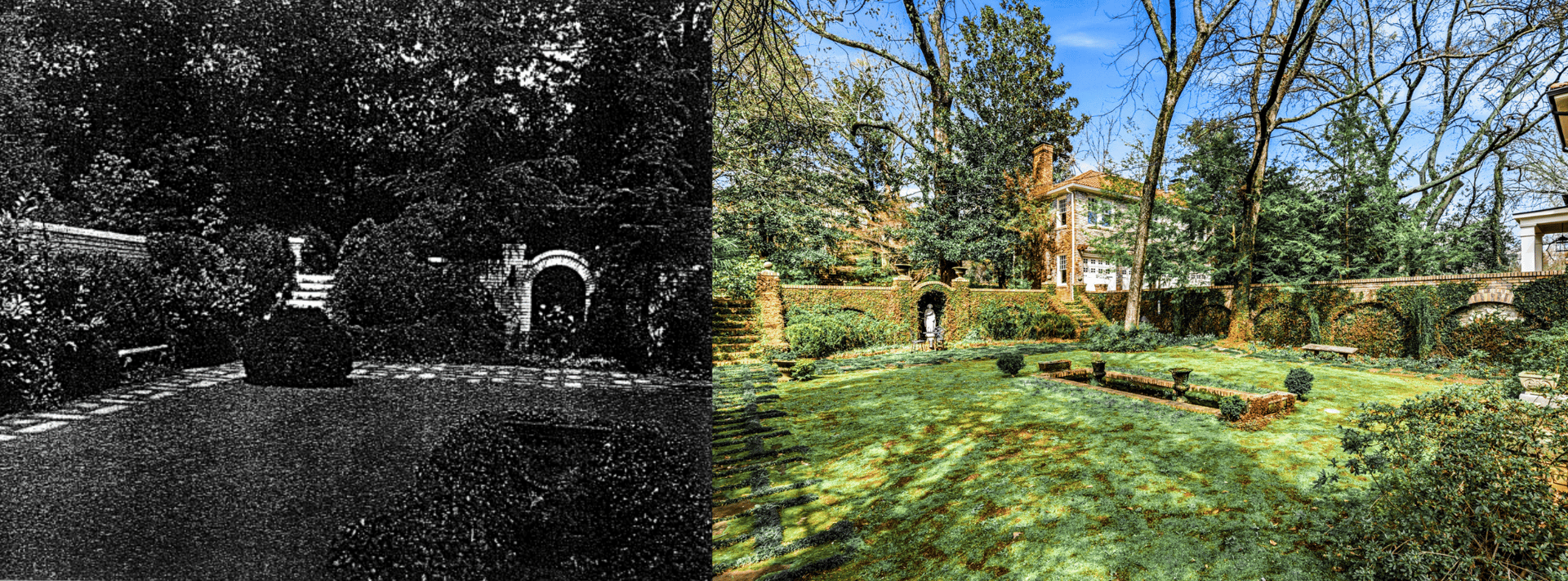
The same walled garden at Boxwoods, nearly a century apart: from Garden History of Georgia, 1933 (left), and today (right).
A Druid Hills estate by the architect Atlanta let get away
Rainwater did not hire just any builder. In 1914 he commissioned Edward Emmett Dougherty, an Atlanta native who had studied at Cornell and then at the École des Beaux-Arts in Paris, the most respected architecture school in the world at the time.
Dougherty was Atlanta’s true Beaux-Arts talent. His commissions included the Druid Hills Golf Club, Druid Hills Baptist Church, and the Imperial Hotel. He later moved to Nashville, designed the Tennessee War Memorial, and won the American Institute of Architects Gold Medal, the highest honor the profession gives. As the historians put it, Atlanta let this native son get away.
The home he designed for Rainwater became known as “Boxwood”, and it sits inside Historic Druid Hills, the neighborhood laid out on a plan by Frederick Law Olmsted, the landscape mind behind New York’s Central Park. The address was no accident. This was where Atlanta’s most serious money chose to live, behind hedges and old oaks, on streets shaped to feel like landscape rather than grid.
The historic gardens that earned a place in a book
Most beautiful gardens disappear with the people who tended them. “Boxwood” was written down.
In 1933, the home and its grounds were featured in Garden History of Georgia, 1733–1933, the Bicentennial Edition published by the Peachtree Garden Club. The boxwood that gives the estate its name had been collected over seventeen years, much of it rescued from abandoned farmhouses and old places whose owners no longer valued it. Three acres were laid out in an intricate, original plan, with boxes of every size and variety used as the bones of the design.
The book describes a sequence of intimate gardens wrapped around the house. A walled green garden served as an outdoor living and dining room, with an ivy-bordered pool and a garden figure set into a niche in the wall. Steps climbed to a semicircle of lawn under ivy-wrapped oaks, then higher still to a formal rose garden. A bridle path looped through a wild garden thick with rhododendron and kalmia, past rock-bordered pools and bird feeding stations. There was a green “judge’s stand” for the boys’ horse shows and an Early American club house with a picket fence and an old farm bell.
These were not decorative beds. This was a private landscape built in the English tradition, and it was considered significant enough to record for posterity almost a century ago.
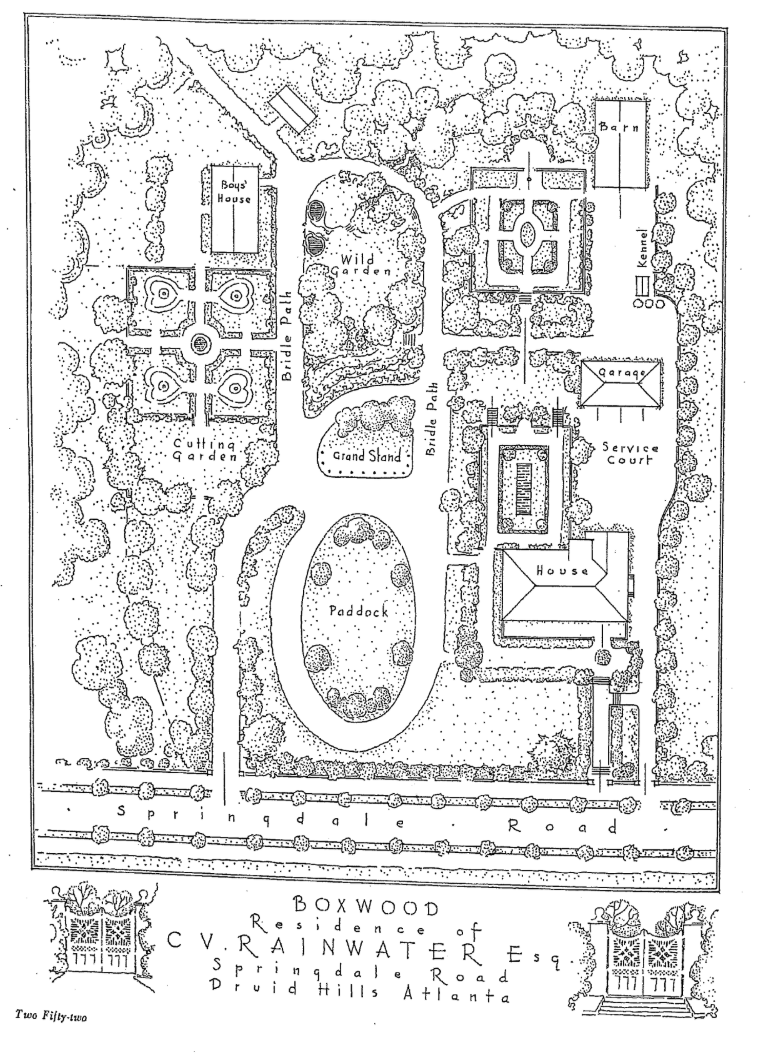
The original plan of Boxwoods: three acres of gardens, paddock, and grounds, from Garden History of Georgia, 1933.
What it means to own a piece of Druid Hills history
The house moved through other chapters over the decades. It appears in the social pages of The Atlanta Constitution as the Rainwaters entertained Atlanta society through the 1920s. Later it was offered for rent, then passed to new owners, the way grand homes usually do.
And then, nearly a hundred years after that garden book went to print, a Rainwater descendant saw the listing and reached out, simply to say they loved it and to share what the place had meant to their family.
Homes like this Boxwood estate do not come to market often, because there are very few of them. A house designed by a Beaux-Arts master, built for the executive who helped standardize the most famous bottle in the world, set on gardens recorded in the history of an entire state. You are not purchasing square footage. You are becoming the next name in a story that people still care enough about to write you a letter.
Interested in walking the gardens and seeing “Boxwood” for yourself? We would love to show you. Reach out to the DOSSIER team to arrange a private showing of 794 Springdale Road NE.